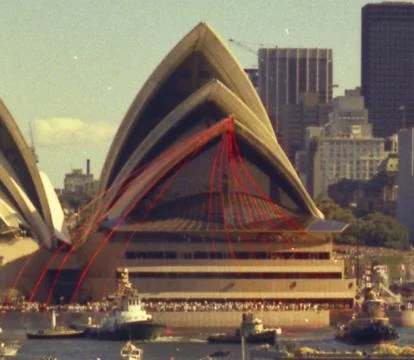
The picture
The Sydney Opera House Trust's own account of its history states that architect Jørn Utzon's shell roofs could not be resolved from drawings alone. According to the Trust's page on the spherical solution, engineers Ove Arup and Partners had been asked in 1958 to express the shell shapes mathematically, and by late 1961 no solution had been found. The breakthrough came while Utzon was physically stacking shell models in his own office and noticed the shells were similar enough to share one constant form: sections of a single sphere. He formalised the geometry in a submission the Trust calls the 'Yellow Book', delivered in January 1962.
What the documents show
Both pages are the Opera House's own retrospective record, not an engineering paper by Arup or Utzon themselves, so they state what the building's institutional history now says about the process, not a contemporaneous engineering log. They establish a clear sequence: a mathematical problem posed in 1958, three years without a solution, a physical-model observation, then a dated 1962 submission making every shell derivable from one sphere. The page adds that the payoff was practical: uniform, repeatable geometry let the roof's tiles and formwork be standardised instead of custom-built for every shell.
What it is allowed to decide
On these sources, the model that produced the spherical solution supported at least Class 5, Technical execution: it fixed a buildable geometric rule that construction then followed, rather than merely illustrating an idea. It plausibly reached Class 6, Regulated artifact, once translated into Arup's engineering submission, though the cited pages describe the architectural narrative, not the engineering drawings, so this entry does not claim the model was itself the regulated document. Of the six authorities, the sources support Physical authority: the model's own geometry, not an artist's impression, is what the design had to obey. They do not establish Photometric authority, since lighting is not addressed here.
The disclosure label
Labelled in the site's own format and dated 16 September 2026, this artifact would read: a physical study model demonstrating shell geometry derived from a sphere; Class 5, Technical execution, with a plausible path to Class 6; holds Physical authority over the geometry it fixes; does NOT HOLD Photometric authority, since lighting is not addressed in the sources describing it. A structural engineer on the Arup team, rather than the architect alone, would plausibly assert this label, since the claim is buildability, not appearance.
- Did a model fix a measurable rule, or only suggest a pleasing shape?
- Who signed off on the geometry once it left the architect's office?
- What in a modern digital equivalent would replace the physical act of stacking parts to see a pattern?
The episode is a reminder that authority does not require a screen. A set of physical models, handled long enough, disclosed a constraint that three years of drawings had not. That is a Physical-authority claim in the site's own terms, earned by the model obeying the same geometry the building would have to obey, not by how convincing it looked on a table.
Sources & reading trail
States Utzon's realisation that the shells could derive from a sphere's surface and gives the Trust's overview of the design and construction period.
Source published: Not established · Retrieved: 16 September 2026
Gives the Trust's account of the physical shell models, Ove Arup and Partners' engineering role, and the 1958-1962 timeline culminating in the January 1962 Yellow Book submission.
Source published: Not established · Retrieved: 16 September 2026
Documentation, handbooks, rulings and records establish the entry; the authority reading and the disclosure label are Previs Office editorial analysis. This retrospective draft does not imply the site published on the event date.