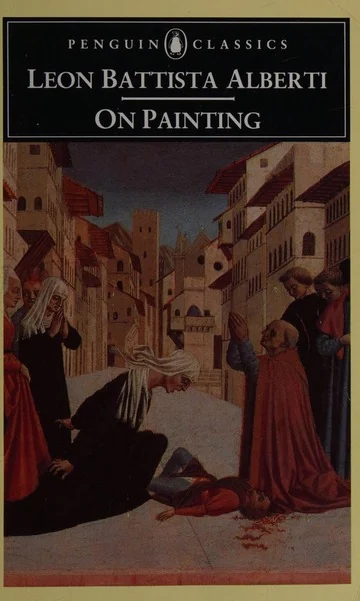

The picture
Leon Battista Alberti's treatise, known in Latin as De pictura and dated by its standard translations to 1435-1436, is catalogued at the Internet Archive in two separate scholarly editions. The Kemp and Grayson translation published by Penguin describes the work as addressing, across its three books, the process of vision, how a painter presents with the hand what the mind has understood, and the moral and artistic qualifications a painter should hold. A second, bilingual edition, Grayson's Latin-and-English text published by Phaidon, pairs De pictura with Alberti's companion treatise on sculpture, De statua.
What the documents show
Both records are library catalog descriptions of modern scholarly editions, not the 1435 manuscript itself, and this entry could not open a full text of either edition to quote Alberti's own method directly; both digitisations are access-restricted for lending, and a hinted museum essay could not be reached because of a persistent rate limit on the publisher's server. What the two records do establish, independently of each other, is the treatise's three-part structure and its 1435-1436 date, and that modern scholarship treats the work as a unified, translatable text rather than a fragment. Neither record uses the phrase single-point perspective or names a vanishing-point construction, so this entry does not attribute that vocabulary to the opened sources.
What it is allowed to decide
On what these two catalog records establish, Alberti's treatise is best placed as a documentary precedent for the site's Optical authority concept: a written method, addressed to painters and architects, for treating vision as something that can be constructed rather than merely observed. Whether the surviving text supports Class 2, Creative approval, is not something these two records confirm; they describe the book's structure and editions, not its use in any approval process, historical or modern. This entry does not guess at that use.
The disclosure label
Labelled in the site's own format and dated 16 September 2026, this artifact would read: a 1435-1436 treatise on painting, structured around vision, execution and the painter's training, known from its standard modern scholarly editions; class not assignable from the sources opened for this entry; plausibly an early precedent for Optical authority, though the specific construction method could not be quoted directly here. An art-history editor describing the edition's own catalog entry, rather than a practicing previs supervisor, would plausibly assert a label this cautious.
- What does it mean for a centuries-old text, rather than a tool, to hold an authority in this framework?
- How would a reader today verify a claimed link between Alberti's method and a specific modern rendering technique?
- What is lost when a foundational text is cited by reputation rather than by an opened passage?
This entry is deliberately narrower than the popular claim that Alberti invented perspective. The catalog records opened here support only that his text formalised a method and that it survives in standard scholarly editions; crediting him with the origin of perspective practice itself would go beyond what these two documents state, and beyond what this entry is prepared to claim on their authority alone.
Sources & reading trail
Catalog record for the standard Kemp/Grayson translation describes the treatise's three-book structure covering vision, the painter's translation of understanding into the hand, and the painter's qualifications, and gives the 1435-1436 composition date.
Source published: Not established · Retrieved: 16 September 2026
A second cataloged edition confirms the original Latin title De pictura and its companion text De statua, corroborating the treatise's authorship and structure independent of the first edition record.
Source published: Not established · Retrieved: 16 September 2026
Documentation, handbooks, rulings and records establish the entry; the authority reading and the disclosure label are Previs Office editorial analysis. This retrospective draft does not imply the site published on the event date.